
• Skip to Content
  • Skip to Main Navigation
  • Skip to Search

Indiana University Indiana University IU

Open Search
  • Movie Categories
    • Germination
      • Corn Germinatin
      • Sunflower Germination
      • Arabidopsis Germination
    • Photomorphogenesis
      • Sunflower
    • Tropisms
      • Phototropism in Arabidopsis
      • Tomato Phototropism
      • Corn Seedlings Phototropism
      • Cool Corn Phototropism
      • Sunflower Phototropism
      • Sunflower Solar Tracking
      • Coleus Solar Tracking
      • Arabidopsis Shoot Gravitropism
      • Coleus Shoot Gravitropism
      • Corn Root Gravitropism
    • Nastic Movements
      • Venus Flytrap
      • Sensitive Plant
      • Sensitive Plant 2
      • Twining Motion of Vines
      • Nutation of Sunflower Seedling
      • Nutation of Tulip Stems
      • Nutation of Shooting Star Flower Stem
    • Circadian Responses
      • Bean Leaf
      • Oxalis Leaf
      • Pumpkin Fruit Growth
    • General Growth
      • Rosette Growth
      • Arabidopsis Root Growth
      • Root Acidification
      • Mungbean Root Growth
      • Leaf Bud Growth
      • Wilting
      • Death by Roundup
    • Flowers
      • Bloodroot
      • Crocus
      • Daylily
      • Iris
      • Lotus Flower
      • Moon Flower
      • Narcisus
      • Passion Flower
      • Primrose
      • Shooting Star
      • Snowdrop
      • Star Lily
      • Sunflower
      • Trout Lily
      • Tulip Tree
    • Cellular Responses
  • Teaching and Learning Projects
    • Plant Projects
      • A Darwin Experiment
      • Chloroplast Movements
      • Flipbook
    • Making Time-Lapse Movies
    • Dancing with Plants
  • Plants & Art
    • Plants in Hollywood
    • Boxtrio
    • Plant Art
    • Images from the Installation
    • About sLowlife
    • The Originators of sLowlife
    • The Sounds
    • Time
    • Power of Plants
    • Photosynthesis III
    • Photosynthesis II
    • Photosynthesis I
    • Orchestrating
    • Microprocessing III
    • Microprocessing II
    • Microprocessing
    • Unseen Acts
    • Sensing & Responding
    • Darwin's Experiment
    • Darwin's Impact
    • Altering Perceptions II
    • Altering Perceptions
    • Introduction
    • sLowlife:an essay
    • sLowlife

Plants-In-Motion

  • Home
  • Movie Categories
    • Germination
    • Photomorphogenesis
    • Tropisms
    • Nastic Movements
    • Circadian Responses
    • General Growth
    • Flowers
    • Cellular Responses
  • Teaching and Learning Projects
    • Plant Projects
    • Making Time-Lapse Movies
    • Dancing with Plants
  • Plants & Art
    • Plants in Hollywood
    • Boxtrio
    • Plant Art
    • Images from the Installation
    • About sLowlife
    • The Originators of sLowlife
    • The Sounds
    • Time
    • Power of Plants
    • Photosynthesis III
    • Photosynthesis II
    • Photosynthesis I
    • Orchestrating
    • Microprocessing III
    • Microprocessing II
    • Microprocessing
    • Unseen Acts
    • Sensing & Responding
    • Darwin's Experiment
    • Darwin's Impact
    • Altering Perceptions II
    • Altering Perceptions
    • Introduction
    • sLowlife:an essay
    • sLowlife
  • Search
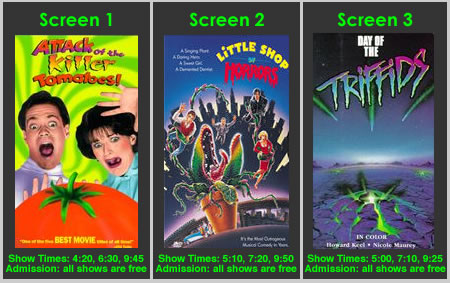
Picture of three different movie posters that are all related to plants and two of the three of them have people on them reacting to situations happening within the poster.

Watch plants do amazing things and learn some interesting stuff while you are at it!

Created for nonprofit educational use
by
Roger P. Hangarter
Indiana University, Department of Biology, 915 E 3rd St, Bloomington, IN 47405

Although our lives depend on plants for virtually everything that keeps us alive (oxygen, food, fibers, lumber, fuel, etc), the lives of plants remain a secret to many people. The reason is simple - plants live on a different time-scale from ours. Compared to the relatively hyperactive activities of humans, plants do not appear to do much but they are actually in constant motion as they develop, respond to environmental stimuli, search for light and nutrients, avoid predators, exploit neighbors, reproduce, etc.

Time-lapse photography allows us to see the movements of plants and clearly demonstrates that plants are living organisms capable of some extraordinary things. Time-lapse photography is done by capturing a series of images at intervals ranging from seconds to hours apart. When the images are viewed in rapid succession the effect is to compress into a short period the changes that occurred over a relatively long period of time.

The movies on this site show a variety of plants living out their dynamic lives. The movies on this site will hopefully captivate the interest of budding plant biologists but many of them should also be of interest to the seasoned plant biologists. New movies will be added to the site occasionally but making time-lapse movies requires time, patience, and some luck so the rate at which new movies will appear is unpredictable. Hopefully you will enjoy the material that is available now.

This site is provided as a resource for nonprofit educational use. Feel free to include a link to this site (http://plantsinmotion.bio.indiana.edu) on your web page or make a copy of movies for in-class presentations. However, copies of the movies may not be included on other web sites. In some circumstances, "for-profit" use may be arranged. The rights to the contents of this site belong to Roger P. Hangarter and Indiana University unless otherwise indicated.

* Site Honors *

Support for creating the material on this site has been provided by
The SBC Fellows Program
The National Science Foundation
and the IU Department of Biology

2000 Roger P. Hangarter and Indiana University. All rights reserved.

https://aspb.org/

Plants-In-Motion social media channels

  • Twitter
  • Facebook
  • YouTube
  • LinkedIn

Indiana University

Accessibility | College Scorecard | Open to All | Privacy Notice | Copyright © 2025 The Trustees of Indiana University